
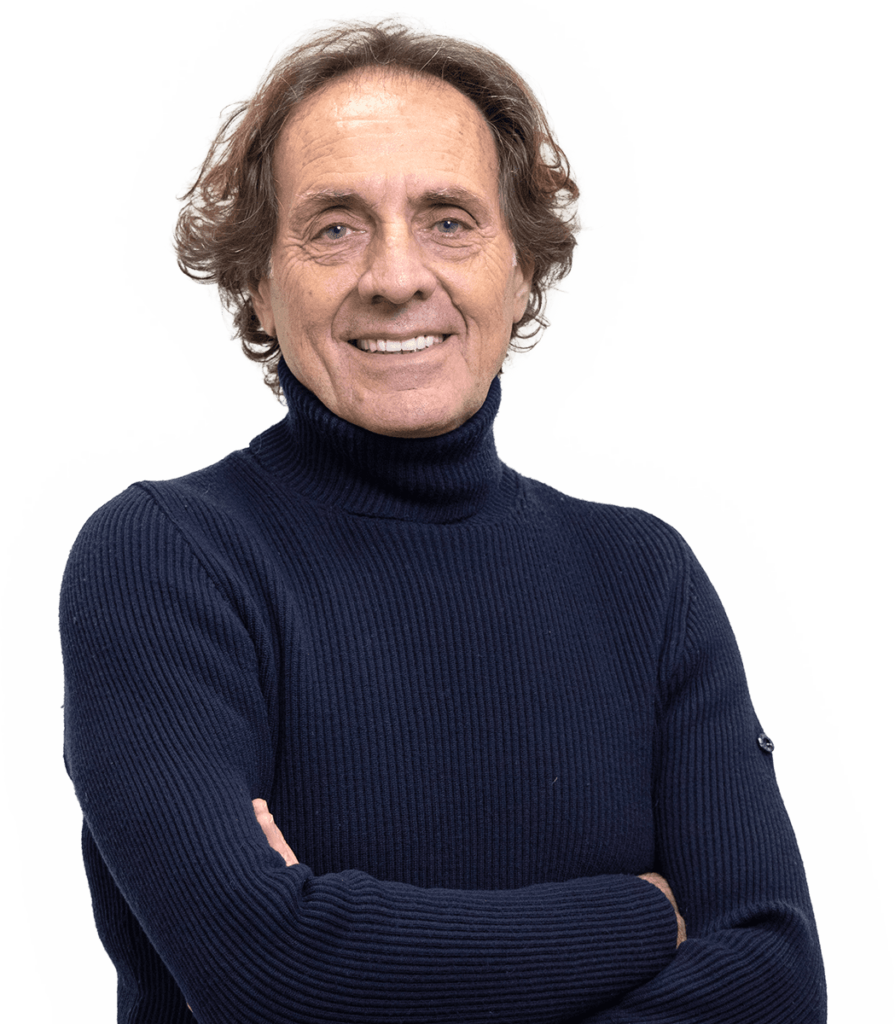
Vincenzo
Scolamiero
Vincenzo Scolamiero lives and works in Rome. He lectures in Painting in the Department of Visual Arts at the Academy of Fine Arts in Rome.
Programme
Making art is tantamount to asking oneself questions; one makes art because one expects answers.
The focus of the course will be on ‘throwing oneself’, without a safety net, into the dynamics of seeking out one’s own poetic vision.
Today, in the world of creativity, regardless of the medium, it is essential to be aware of one’s own path, of why one has chosen this path (communication through visual language in our case) and of how one intends to pursue it.
However, knowing precisely what our communication is and how to make it precise, clear and distinct is the most complex and challenging aspect of our work.
The daily decision to analyse our motivations is the most fascinating task that the path of communication compels us to undertake. However, to do this consciously, we must start by understanding the world around us… or at least try!
We live in a world where communication is highly interconnected, not only because of the technological tools available to us, which are easy to use, but also – and this is the aspect that concerns us most – because, in today’s communication, the languages used are increasingly hybrid, i.e., formed by connections, intersections and crossovers between different linguistic forms. Today’s artists, whatever their specific path, are cultural agents, catalysts of ideas, who create complex journeys fuelled by exploration, analysis and abandonment. Therefore, broadening our cultural and creative horizons is more important than ever. This does not mean that we cannot make traditional, straightforward choices; it does not mean that we cannot paint joyfully at our easel or push ourselves along our own creative paths in search of our own stylistic signature.
However, it does mean that, beyond the paths we choose, we need to grow culturally, broaden our horizons of knowledge, keep ourselves informed, and relentlessly seek out ideas and content, including in parallel artistic forms (music, literature, poetry, cinema, theatre, dance, etc.), in order to expand our sensibilities and be able to imbue every sign and every step with meaning. We all know that great art (in the broad, literal sense), including great painting (to be clear), has never been limited to formal language alone. A beautiful painting, a well-written text or a fine photograph is not enough if it is not imbued with poetic meaning. If it does not carry meaningful content with it. To avoid any misunderstanding, I am more convinced than ever that even so-called easel painting today can have (indeed, it possesses it to the greatest possible extent! And I say this with conviction) a profound, conscious, well-founded meaning, thanks to its ethical significance, its sense of belonging, its capacity for resistance and therefore also its political meaning, and its emotional appeal… in short, it can have, and does have, a strong anthropological meaning today, just as it did in the past. We must be clear on this point. However, we can only gain a profound understanding of things and expand our repertoire of stimuli and personal development by educating ourselves as broadly as possible, by venturing in a thousand directions around us, by reading, by listening, by empathising with all the languages that surround us and with all the signals that the world sends us in a thousand different ways. For this reason, I would like all of you, every student on the two-year course, to look around yourselves for an idea, a stimulus on which to reflect and around which to develop a project – a heartfelt, in-depth reflection stemming from something that can move us, captivate us, both emotionally and intellectually.
Taking the time to read, to listen, to seek connections, links between forms and words, between sounds and colours, between artists, poets, composers… is of fundamental importance today, as it was in the past, for all of us.
What is needed is a strategic vision: identifying one’s own path, aligning it with real needs, and developing intelligent, long-lasting responses.
Today, the teaching of ‘painting’ should be understood in a broad sense, as an opening up to creativity and artistic production, both through painting itself and through the various languages that make up the artistic lexicon today. Therefore, a curriculum that addresses the complexity of the world we live in and with which we aim to engage in dialogue cannot be separated from a broad cultural openness and knowledge of different languages, as well as from the specific techniques of one’s own way of working. Indeed, the programme will not pursue predetermined stylistic content or favour specific technical/linguistic forms; rather, it will seek to explore in depth and facilitate the independent development of individual pathways. Therefore, the aim of the course is not merely to provide in-depth knowledge of the basic techniques of painting, but also to develop a thematic/critical understanding and an analytical capacity for observation, presentation and the construction of students’ own original linguistic and content-related pathways.
During the lectures, various topics will be explored through video screenings and meetings with artists, poets and writers, in order to discuss the cultural world around us. Topics will be proposed and concepts will be addressed that form the foundation of all poetics related to artistic communication.
Students will be encouraged to chart their own independent path, using an appropriate and in-depth language that can bring the chosen content/subject to light.
During the semester, students in the second year of the two-year programme will be required to give a short presentation of their work, displaying it and discussing it in front of the class.
Indeed, it is very important for the artist’s personal development to become accustomed to speaking and explaining their motivations, as in their professional life they will be constantly called upon to engage in dialogue with gallery owners, art dealers, curators and critics, who will need the artist’s words to gain a deeper understanding of the context of their artistic vision. Acquiring an appropriate language and the ability to observe and discuss the content of contemporary art is of the utmost importance in the training of today’s artists.
Furthermore, again with a view to developing and fostering students’ capacity for critical reflection, for the examination, they will be required to submit a short report (a page of 500–1,000 characters will suffice) on an exhibition they have visited at a private gallery, museum or other venue, which may be accompanied by a brochure, leaflet or photographs of the exhibition.
The focus of the first year is the development of a clear and coherent personal portfolio in which students can express their content, artistic vision and chosen technique in a simple and effective manner.
The focus of the second year is the development of a personal project structured in a way that would be suitable for responding to a hypothetical public call for proposals.
Both tools are essential, once students have completed their course of study, for pursuing their artistic career in a professional manner.
Among the books listed in the reading list, I recommend the following, among others:
Italo Calvino, Six Memos for the Next Millennium, Harvill Press, London 2006
Rainer Maria Rilke, Letters to a Young Poet, Adelphi, Milan, 1980
Gabriele Simongini, Arte e identità della specie umana, Manfredi Edizioni, Imola, 2022
Roberto Gramiccia, Se tutto è arte, Mimesis Edizioni, 2019
Salvatore Settis, Futuro del classico – Einaudi, Turin 2004
Wassily Kandinsky, Concerning the Spiritual in Art, SE Studio Editoriale, Milan 2014
Suggested reading list:
1. Alberto Boatto, Narciso infranto, Ed Laterza, Rome, 1997
2. Angela Vettese, Si fa con tutto, Ed. Laterza, Rome, 2017
3. Ernst H. Gombrich, The Story of Art, Leonardo Arte, Einaudi, Turin, 1965 Einaudi, Turin, 1965
4. Flavio Caroli, Le tre vie della pittura, Electa, Milan, 2012
5. G. Di Giacomo, C. Zambianchi, Alle origini dell’opera contemporanea, Ed. Laterza, Rome, 2010
6. Gillo Dorfles, Dall’informale al postmoderno, Ed. Feltrinelli, Milan, 1961
7. Hans Belting, Facce – una storia del volto, Ed. Carocci, Rome, 2014
8. Hermann Hesse, Siddhartha, Adelphi, Milan, 1968
9. Paul Valery, Scritti sull’arte, Abscondita, Milan, 2017
10. Philip Ball, Colour: A Biography, Rizzoli, Milan, 2001
11. Sally O’Really, The Body in Contemporary Art, Einaudi, Turin, 2011
12. Vincent Van Gogh, Letters to Theo, Guanda, Milan, 1984
13. Vittorio Sermonti, Le metamorfosi di Ovidio, Rizzoli, Milan, 2014
14. Wassily Kandinsky, Point, Line, Surface, Adelphi, Milan, 1968