
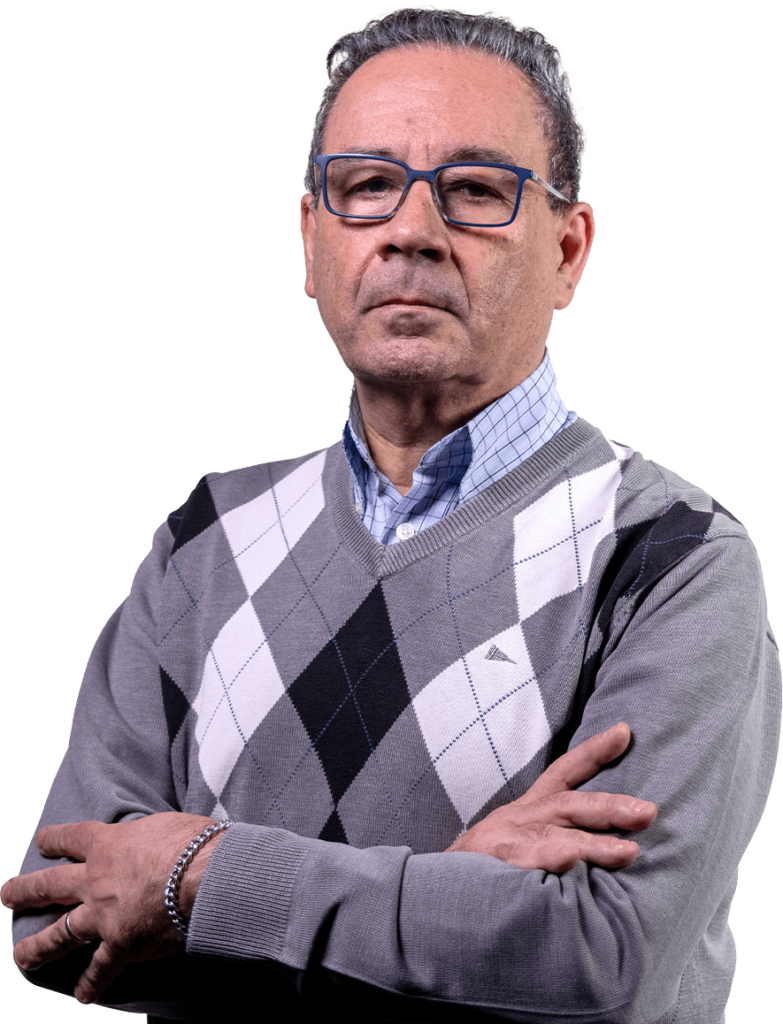
Roberto
Pace
He lives and works in Rome and has been exhibiting his work since the 1970s. He is known for his participation in the exhibitions ‘Le alternative del nuovo’ (Rome–Livorno–Ferrara, 1979/80); ‘Anni Ottanta’ (Bologna, 1985); and ‘Arte e alchimia’ (Venice Biennale, 1986). In the 1980s, he exhibited regularly at the Salvatore Ala Galleries in New York and Milan and at the Ugo Ferranti Gallery in Rome. Since the 1990s, his reflections on the cornerstones of abstraction have led to a transformation in his use of the image and its interpretation in exhibitions. In 2002, with the exhibition ‘Doppio3verso’ (with Roberto Rizzoli) at the Scuderie Aldobrandini in Frascati, he initiated the exhibition project ‘film con sottotitoli’ (‘film with subtitles’), where ‘film’ refers to the thin layer of paint and evokes the temporal unfolding of the image, and ‘with subtitles’ denotes a theory derived from perceptual descriptions rather than from content. This was followed by: ‘Anteprima’ (Rome, 2005), ‘Eidos’ (Bassano Romano, 2007); ‘Il sole’ (Rome, 2009); Scuderie Aldobrandini (Frascati, 2011). His most recent exhibitions spatialise the images beyond conventional perceptual formats, placing them in environments characterised by the sedimentation of culture, and posit that the work is realised over time through the enhancement of its perception: ‘Lo studio in vacanza + il paradiso’ (Ipsar, 2014); ‘Lo scatolone di Fuksas / la nuvola di Libera’ (EUR Palazzo dei Congressi, 2014); ‘Tam – Tam + Film con sottotitoli combo + Il sabba didattica: Archiginnasio’ (Ruffilli Library, Bologna, 2015); ‘DARK ROOM: ormeggio a Ugo Ferranti’ (Tibaldi, Rome, 2018). With ‘il sabba didattica’ (2015/2016), ‘Accademia di belle Arti’ (2016/2017) and ‘Transformers’ (2018), he experimented with a new educational format. In 2023, the exhibition ‘Stampa Digitale 2010–2022’ held in the Aula Colleoni reinvented the educational experience he had developed, with an installation that revisited its history. The publication in 2024 of the ‘Manuale stampa digitale’ (‘Digital Printmaking Manual’) for the GliOri publishing house completes the exhibition project with a volume in which the focus shifts from technique to theory.
She has been a lecturer in printmaking and digital print techniques at the Academy of Fine Arts in Bologna since 1992 and at the Academy of Fine Arts in Rome since 2010.
Introduction to the Digital Printing Laboratory.
Digital printing is the latest addition to the centuries-old history of printmaking and enables us to rethink the production of printed images in the artistic sphere, discovering new relationships between tradition and modernity.
The workshop provides a technical refresher and explores the possibilities offered by the latest technologies through lessons structured as educational events; personal sensitivity is enhanced through the creation of digital plates, the scanning of drawings and paintings, and the combination of both.
In the past, the techniques used to reproduce images required long development times before they could be used for expressive purposes; today, we can immediately divert new technologies away from commercial use and employ them in a visionary way, bringing technology into dialogue with contemporary art in order to rethink its use. Italian visual culture is characterised by a unique sense of continuity with the past, where the term ‘Renaissance’ encapsulates the ability to conceive of the new not in opposition to the old, but rather to recognise the possibility of renewal as the very heart of tradition.
Digital printing represents a point of convergence and exchange between the manual and the digital, between abstraction and photography, and between personal sensibility and new content. In the workshop, we will conduct a practical exploration of surfaces printed using the digital process and compare them with the analogue image-creation methods covered in the other courses.
In our workshop, we use small- and large-format Epson inkjet printers; a professional scanner; and a printing press for letterpress printing and mounting. At external servers, we will experiment with the new UV plotters; for very large formats and new media, we will use online printing; and we will relate all of this to traditional printmaking and manual techniques, reimagined in line with these new objectives.
2025/2026 PROGRAMMES
Printmaking Techniques (Digital Printing) – Three-Year Programme – Painting, Other Schools
1st semester, Classroom 1, Wednesday, 8/16
- (In the second semester, there will be dedicated printmaking review sessions – personal projects can be shared via email)
The programme is single-subject in nature and changes each year. It focuses on printmaking and materials, guiding the digitally created image (scanning + Photoshop) from virtual processes to tangible realisation, developing its full potential, because it is precisely in printmaking that its true originality is revealed. The current interest in artisanal techniques is being revived by technology, which is once again embracing a rediscovered naturalness and a new form of craftsmanship. A key aspect of our workshop practice will be the stimulating task of rekindling a connection between the digital and the analogue, linking formal research with the development of meaningful content, and reimagining new and traditional technologies without pitting them against each other. The final works will be printed and mounted in our workshop to a museum-quality, fine-art standard.
Printmaking Techniques (Digital Printing) – Two-Year Course – Painting, Other Schools
1st semester, Classroom 1, Thursdays, 8/16
- (In the second semester, there will be dedicated printmaking sessions – personal projects can be shared via email)
The theoretical programme is delivered in the workshop during the first semester and may be pursued independently by each enrolled student in the second semester for the summer examination session. During the course, an up-to-date technical approach is developed in the light of the work of contemporary artists (Avatars), from which students can draw procedural guidance for printmaking and gain access to the new content being developed in Contemporary Art. Each student develops a personal project based on their research, in which they apply and expand upon what they have learned and experienced in class. Specifically, on the production side, the course focuses on large-format digital printing, providing a practical overview of its new features, using the various media available, and applying the different digital printing techniques on the market for publications, installations and exhibition productions.
Bibliography:
*The list of publications below provides a broad overview of the contemporary culture to which the course refers. In some cases, it may be recommended to purchase these volumes. As is my practice, the supporting texts for the lectures are available for download in PDF format. Out-of-print volumes can be consulted in the classroom upon request.
Angela Duckworth, Grit: The Power of Passion and Perseverance, Penguin, 2016
*Alongside the previous text (D. Coyle), this is a manual that, although not technical or artistic, is essential for the work students need to do on themselves in order to work in a genuinely creative way.
Daniel Coyle, “The Talent Code: 52 Proven Ways to Unlock Your Full Potential”, Rizzoli Etas, 2013
*The original title is ‘The Talent Handbook: How to Improve Your Skills’, so the focus is not on success but on skill – on genuine ability rather than high grades. To challenge oneself in a positive way.
Jeff Schewe, Digital Printing: Preparing Images in Lightroom and Photoshop for High-Quality Prints, Pearson, 2014
*A comprehensive handbook on fine art printing.
David Bate, Il primo libro di fotografia (nuova edizione ampliata), Einaudi, 1988/2017.
*An essay on photography, brilliant and innovative compared to other texts, focusing on the key techniques for the image work we produce. The new edition includes important chapters on digital photography.
Giuliana Bruno, ‘Superfici, a proposito di estetica, materialità e media’, Johan Levi, 2016.
*An essay on vision becoming tactile in cinema and the work of contemporary artists.
Tommaso Labranca “Vraghinaroda; viaggio allucinante tra creatori, mediatori e fruitori dell’arte”, 20090, 2015.
*An ironic journey through the contemporary art scene.
Brian O’Doherty, Inside the White Cube, Johan Levi, 2012
*The classic text to start from when considering curating an exhibition today.
Nicolas Bourriaud, ‘Estetica relazionale’, Postmedia books, 2010
* A well-known text that explains the new formal, procedural and content-related canons in art over the past 20 years.
Charlotte Cotton, “La fotografia come arte contemporanea”, PBE Einaudi, 2010.
*Photography has become one of the core techniques for the contemporary artist.
Gian Piero Brunetta, “Il viaggio dell’iconauta. Dalla camera oscura di Leonardo alla luce dei Lumière”, Marsilio, 2009
*The history of the transition from static to dynamic images that preceded cinema.
Germano Celant, “Artmix – flussi tra Arte, architettura, cinema, design, moda, musica e televisione”, Feltrinelli, 2008.
*In contemporary art, the use of and transition between all the arts has become essential, and above all necessary, in order to fully express one’s creativity.
Domenico Liggeri, “Musica per i nostri occhi – storia e segreti del videoclip”, Bompiani, 2007.
*Cinema + music + brevity + dissemination. An example of synergistic and popular creation.
Gabriella Taddeo, “Ipercinema – l’immaginario cinematografico nell’era digitale”, Guerini, 2007.
*Cinema, the new art par excellence, is changing.
Various authors, “Arte dal novecento; modernismo, antimodernismo, postmodernismo”, Zanichelli, 2006
*This book stands out from other volumes on 20th-century art history. It provides an overview of new critical methodologies and employs an innovative structure to reorganise the interpretation of art.“Material World” / “Material World 2, innovative materials for architecture and design”, Frame Publishers, Amsterdam + Birkhauser, Basel–Boston–Berlin, 2006
*Extraordinary new materials are being produced, leading to a sensibility that dematerialises reality.
Josef Albers, Interazione dei colori, Il Saggiatore, 2005
*Albers is a cornerstone of modern art. He has influenced everyone. Like Morandi and his concept of the grid in printmaking, Albers introduced the principle of colour interaction, which transforms the way we see.
Rosalind Krauss, “Celibi”, Codice Edizioni, 2004
*A study – admittedly complex – that highlights how female creativity differs from male creativity.
Rudolf Steiner, “The Essence of Colours”, Anthroposophical Publishing House, 2003
*Regardless of whether one accepts the ideas of anthroposophy or not, the book is fascinating because it presents an alternative approach to colour to the usual ones.
Fabio Bonvicini, “Incontri ravvicinati – interviste agli specialisti italiani del cinema digitale”, Lindau 2003.
*How do we get to the digital and the virtual? By changing our mindset.
Angela Vettese, Artisti si diventa, Carocci Editore, 2001
*An in-depth analysis of the artist’s profession, supported by data and tables.
Augusto Pieroni, “Leggere la fotografia”, Edup, 2000
* A quick and affordable handbook; a glossary packed with technical definitions and web addresses.
Luciano Fabro, “Arte torna Arte. Lezioni e conferenze”, pbe Einaudi, 1999.
*One of the most important books of recent years. It is unique in that it brings together the lectures and educational talks of Luciano Fabro (1936–2007), one of the key post-war artists, who devoted a significant part of his life to teaching. Anti-academic, comprehensive yet written without technical jargon, perhaps irritating but, precisely for this reason, imbued with respect for his students.
Susan Talman, “The Contemporary Prints, from Pre-Pop to Postmodern”, Thames & Hudson, 1996
*An in-depth study of contemporary printmaking that describes how, from a subordinate role, it has become central, with its own techniques, to contemporary creativity.
Germano Celant, “OFFMEDIA – Nuove tecniche artistiche: video, disco, libro”, Dedalo Libri, 1977.
*The first study to ascribe artistic value to the new media, all of which operate in the field of reproduction and create a technological matrix.