
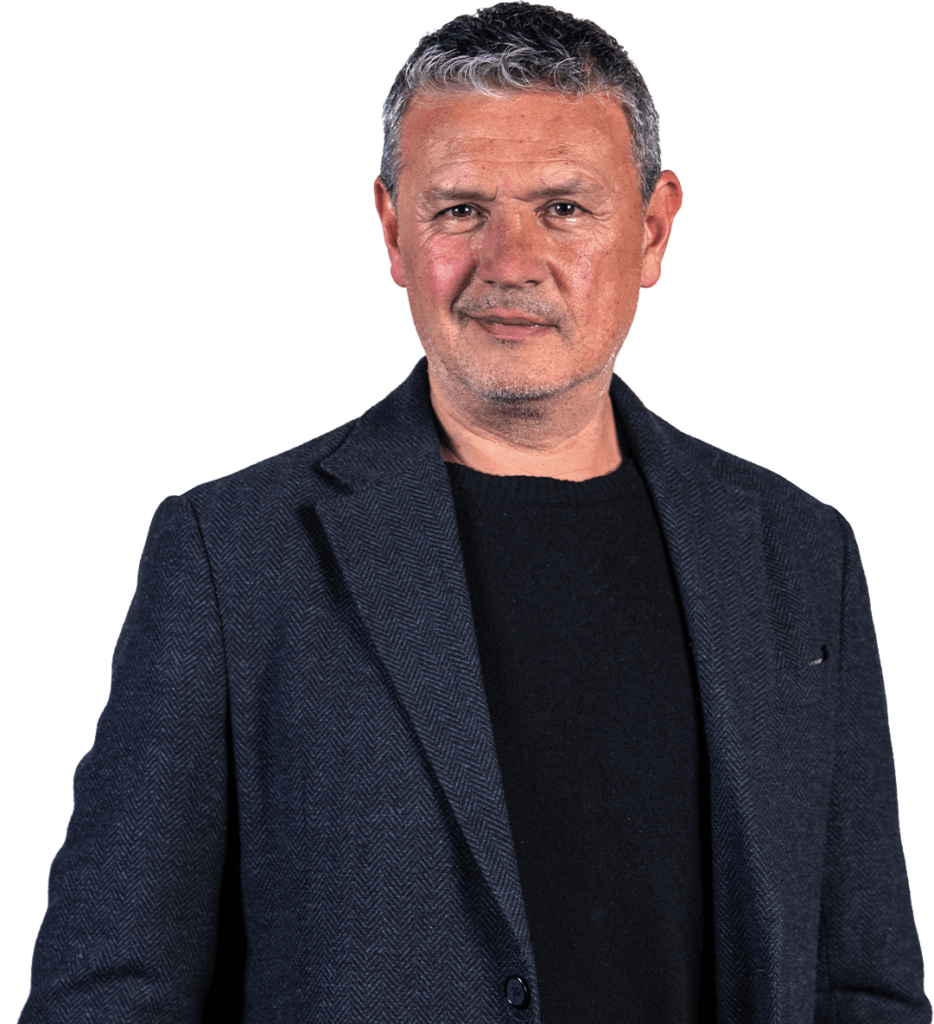
Vincenzo
Cinque
Education:
1993 – Obtained a diploma in painting from the Academy of Fine Arts in Naples.
Selected exhibitions:
In 1999, she won the International Competition for a public work to mark the Bicentenary of the Neapolitan Republic, a permanent work in Portici (Naples), with Gillo Dorfles as chair of the selection committee. In 2003, he took part in the 14th Quadriennale di Roma – Anteprima Napoli. From the 1990s to the present, he has exhibited at galleries and institutions in Italy and abroad: Galleria F. Riccardo; DAFNA Gallery; PAN Museum – Palazzo delle Arti, Naples; Fondazione Plart, Naples; Galleria Paola Verrengia, Salerno; Summer Kisses, Palazzo Lucarini Contemporary Art, curated by Maurizio Coccia, Trevi (Perugia); M.L.B. Home Gallery, Ferrara; Galerie Piece Unique, Paris; Waltman Ortega Fine Art, Miami (USA). In 2008, he was selected for Natura e Arte in Certosa: Ortur Artis and Fresco Bosco, curated by Achille Bonito Oliva, Certosa di San Lorenzo, permanent installation, Certosa di Padula, Salerno; ‘Sistema Binario’, curated by Adriana Rispoli and Eugenio Viola – Naples Metro, Mergellina station; 2007 ARIA – Ermanno Casoli International Prize, curated by Valerio Dehò, permanent collection, Serra San Quirico, Ancona; 2005 Napoli Presente, curated by Lòrànd Hegyi, PAN Museum, Naples; Those Misunderstood, curated by E. Viola, University of Naples ‘Federico II’, Capua; 2004 Sogno comune, curated by ESC, Galleria Lia Rumma, Naples; 2001 Think 1 Thing, curated by ESC, Galleria Lia Rumma, Naples; 2000 Andes Prize, curated by Aldo Grazzi and Quartapittura, Museo Virgiliano, (MN); in 1993, he was selected for the 2nd Biennale del Sud – Quando le Accademie scelgono le Arti, curated by Giovanna Cassese and Gianni Pisani, touring exhibition – Berlin, Brussels, London and Naples; 1993 Officine Napoletane: Artiaco, Carola, Framart Studio, Rumma, Morra, Trisorio, curated by Arcangelo Izzo. 1992 – Arena 92 Prize, curated by Arcangelo Izzo, Sarno (SA); Among his most recent exhibitions: 2020 – Into the Wood Under the Night Sky, curated by Cecilia Cecchini. NAJM Project. PLART Foundation – Naples.
Selected publications:
• Fresco Bosco 2006/2008, Achille Bonito Oliva, Prearo ed.,, Milan, 2010
• Art Basel Miami Beach, Annual Art Magazine, D. Sausset & R. Leydier ed.,, USA, 2009/2010 • Art Miami, 21st Edition, USA, 2010
• Marcello Cinque – skip_intro 11: ultracontemporary art books, Massimo Tantardini ed.,, Brescia, 2009 • Sistema Binario. Stazione metropolitana Margellina Napoli, edited by Eugenio Viola and Adriana Rispoli, Paparo Publishers,, Naples, 2008
• ARIA, Ermanno Casoli International Art Prize, 10th edition, Grafis ed., Bologna, 2007
• Napoli Presente, Electa,, Naples, 2005 • Ritratti d’Autore, edited by D. Gallone, Guida,, Naples, 2003
• Quadriennale di Roma 2003, De Luca Editore d’Arte, 2003
• Quando le Accademie scelgono le Arti, Electa ed.,, Naples, 1993
Selection of international contemporary art fairs:
2013 – Art Stage, Galerie Pièce Unique, Singapore
2013 – Art Basel Miami Beach, Galerie Pièce Unique, USA
2012 – Art Dubai, Galerie Pièce Unique, United Arab Emirates
2011 – Art Basel, Miami Beach, Galerie Pièce Unique, USA
2011 – ArteFiera Bologna, Galerie Pièce Unique, Italy
2011 – Art Dubai, Pièce Unique Gallery, United Arab Emirates
2010 – ArteFiera Bologna, Galleria Paola Verrengia, Italy
‘When I paint, I don’t think about exhibitions. You paint because you need to, not for an exhibition or for the market. The primary relationship is between the painter and their work, and when they feel an inner need for a five-metre surface, they paint for five metres.” Toti Scialoja
‘Painting today’: ‘How does the work of painting respond after the great creative ferment that history has passed down to us?’ Many questions come to mind, all of them creative and innovative responses, in which the artist’s curiosity knows no bounds in discovering new visual combinations and taking on new challenges in the field of art. “Making paintings” embodies the very concept of “passion”, which must be nurtured in order to discover new experiences, to become enthusiastic, and to find joy in one’s work. The language of the painting is a question that remains open and is still evolving; it is the need to use one’s own expressive means to invade a space that is somehow altered, both expressively and reflectively, where the painting process is constantly evolving across time and space, in order to discover the many possible tools for pursuing personal visual research.
The aim of the Painting course is to broaden students’ knowledge of contemporary art, focusing on its most defining aspects and criteria, as a fundamental foundation and support for the development of visual language. A key part of the creative process is discussion, debate and keeping abreast of current and culturally relevant issues, with the aim of strengthening and stimulating students’ curiosity in their own artistic research.
The teaching method employed aims to encourage and stimulate exploration, discovery and the development of an individual and personal visual language, identifying in each student, throughout the various stages of the work, their expressive and reflective theme through the discipline and technique of painting. Throughout all these stages, the work is planned and developed with the aim of gaining mastery and confidence, from the planning phase through to the creation of the final piece.
For the three-year and two-year courses, after reviewing students’ previous work and experience in relation to their training background, an educational project is proposed that aims to help students understand and develop the potential required to pursue a career in the visual arts. During the course, students will be required to produce and present a project involving the creation of a work of art as the result of their exploration of a personal and/or collective expression of the skills they have acquired. The working tools are selected following a phase of experimentation and classroom exercises, using a variety of materials and media, from the most traditional to the more contemporary options that artists often discover or invent. Various topics will be covered during the academic year, including: materials and themes of the painting, the study and analysis of the evolution of the painting over time and space, the stratification of the work, eco-sustainable painting, the human body and space, pictorial sign and gesture, the open work and new horizons of the imagination, the surface, the stages and timeframes of painting, two-dimensional and three-dimensional space, and how the painting interacts with it. Throughout the academic year, there will be regular reviews and group discussions on the topics covered and on the paintings produced.
Various practical exercises will be carried out in the classroom, ranging from the study and preparation of the support-surface, such as paper, cardboard, canvas and stretcher frames, and wood, to painting techniques (tempera, watercolour, inks, acrylics, oil painting, pigments, binders, monochrome painting and glazes), culminating in experimentation and the identification of their practical application in the work produced. For the students on the course, it will be essential to experiment with various pictorial combinations in order to master the materials used through both physical and mental practice.
The training programme provides in-depth knowledge of art history and artists, both past and present, in order to analyse and understand the conceptual process by which a work of art is created and develops. Throughout history, in every historical context, works and artists have always interacted over time. Creativity is nourished by the continuous input and shaping provided by everyday experiences. It will be important to further explore the presentation of students’ own visual research, supported by images, portfolios and any other information deemed relevant.
For students on the three-year course, the programme begins with experimentation and classroom exercises using different painting techniques, including acrylics, tempera, inks and oil paint, on various substrates such as paper, cardboard, canvas and wood, with a focus on developing each individual student’s skills and identifying the different themes to be explored for their own painting project. Guidance will be provided on the materials to be used in order to produce environmentally sustainable paintings. During the lectures, open group discussions on the creative process will be held, covering the following topics: pictorial space and surface; the preparation of supports (canvases and stretcher frames, wood, paper and cardboard); line; pictorial gestural expression; the human figure and space; the landscape of our time; and contemporary influences. Students will explore the development of their own visual research in greater depth in order to strengthen the creative process, analysing the various stages of the painting techniques they have learned, in all their formal aspects, with the aim of continually refining the work they produce. This exploration is an ongoing process aimed at discovering new visual codes and consolidating the concept of a final project.
For students on the two-year course, after reviewing the skills acquired during their educational training, they will have the opportunity to further develop their visual research, seeking to establish a dynamic understanding of the possible relationships with the evolving art system and of how artists can pursue pathways in the field of visual arts. They will analyse the formal aspect of the work from multiple perspectives, not only as a finished piece, but also by considering all its possibilities and potential, through an educational project aimed at experimenting with and proposing projects in the field of visual arts. It will be important to further develop the presentation of students’ work as a research project aimed at establishing professional contacts in the contemporary art sector. Throughout the academic year, meetings will be organised with curators and artists active on the contemporary art scene in order to create a meeting point and gather as many accounts of journeys and experiences as possible, which will be useful for enhancing the development of students’ work.
Organisation and creation of the personal portfolio. The portfolio to be created must be a clear and well-organised digital document (PDF) that presents the student’s visual research journey in all its phases. It must contain: a brief description that summarises and focuses on the essence of the student’s research (when and how it began, how and what they create, the objectives set and achieved); a short biography (education, solo and group exhibitions, residencies, workshops, etc., with the dates and locations where they took place); and images of the works, with captions indicating the title, year, dimensions and technique used, either in chronological order from the most recent or grouped by theme. The images must be clear and uncluttered. The same font/typeface must be used for the text and the captions of the works. This work will be developed by all students throughout the academic year and will be assessed as part of the Painting exam. To sit the end-of-course exams, students are required to develop a painting project, outlining the various stages of its creation and presentation, as well as their own visual research.
Luciano Fabro, “Arte torna arte”. Einaudi, Turin, 1999
G. de Chirico, “Piccolo trattato di tecnica pittorica”, Abscondita, Milan, 2013
Gillo Dorfles, ‘Ultime tendenze nell’arte di oggi’, Feltrinelli, Milan 2009
Paolo Vagheggi, “Contemporanei” conversazioni d’artista”, Ed. Skira, Geneva–Milan 2006
Adriano Zecchina, “Alchimie nell’arte”, Zanichelli Editore, Bologna, 2016
Brian O’Doherty, ‘Inside the White Cube’, Johan & Levi Editore, Truccazzano (MI), 2012
Flavio Caroli, “Arte d’oriente arte d’occidente” Ed. Electa, Milan 2012
Hans Ulrich Obrist, ‘Fare una mostra’, ed. De Agostini, Novara, 2014
Germano Celant, “Artmix – flussi tra arte, architettura, cinema, moda e televisione”, ed. Feltrinelli, 2021
Filiberto Menna, ‘La linea analitica dell’arte moderna’, ed. Enaudi, 2001
Angela Vettese, ‘Capire l’arte contemporanea’, ed. Allemandi, Turin 2021
La Quadriennale di Roma, ‘Quaderni d’arte italiana’, edited by G. M. Tosatti, Treccani, Rome 2022