
Following the 2022 exhibition, “Multiplo di tre”, the Academy of Fine Arts in Rome once again enthusiastically took part in Short Theatre, a multidisciplinary festival that has been offering the city a rich and varied programme of shows, performances, installations, workshops and concerts every year since 2006.
Radical Sympathy is the name of the 2023 edition of Short Theatre, chosen to evoke a similarity: Like the sympathetic ink that brings to the surface something hidden but already there, the festival brings to the surface elusive chords and wanderings rooted in the present. Sympathy — here it is a magnetising, impersonal perception, similar to gravity, which causes external things to enter, to muddy the waters, and to emerge to participate in new waves of encounters. A transfer of states in an incessant in-and-out. Sympathy is radical, because it is beyond us, because it draws us into an elsewhere of judgement, into the acceptance of the unusual.
On this occasion, Giulia Barone, Tullia Nocca, Marco Pepi and Maria Giovanna Sodero, four students and former students of the Academy of Fine Arts in Rome, exhibited their works in the Mattatoio – Spazio Pelanda area for the entire first week of the festival, from 7 to 10 September.
The exhibition, curated by Ernani Paterra and Luca Valerio, was entitled “Alla voce del verbo abitare” and interpreted the theme of the festival in a transversal way, in a reflection on the concept of home and the domestic dimension:
àbito: n. m. [from the Latin habĭtus -us, derived from habere in the sense of “to behave”]
abitare: transitive and intransitive verb [from the Latin habitare, properly “to hold”, frequentative of habere “to have”]
These two terms and their meanings lend themselves to many possible variations, which in the works on display have taken different forms through the artistic languages of photography and the audiovisual: from documentary to performative act, from installation to the use of the family archive.
Man loves everything that serves his comfort
and hates everything that annoys him and wants to tear him away from the secure position he has achieved.
That is why he loves the home and hates art.
(Adolf Loos, architect)
Below is an account of the works on display through the words of the curators and former students involved in the exhibition:
Giulia Barone, Il vuoto è fertile

Giulia Barone, Il vuoto è fertile – Photographs, installation, environmental dimensions, 2022
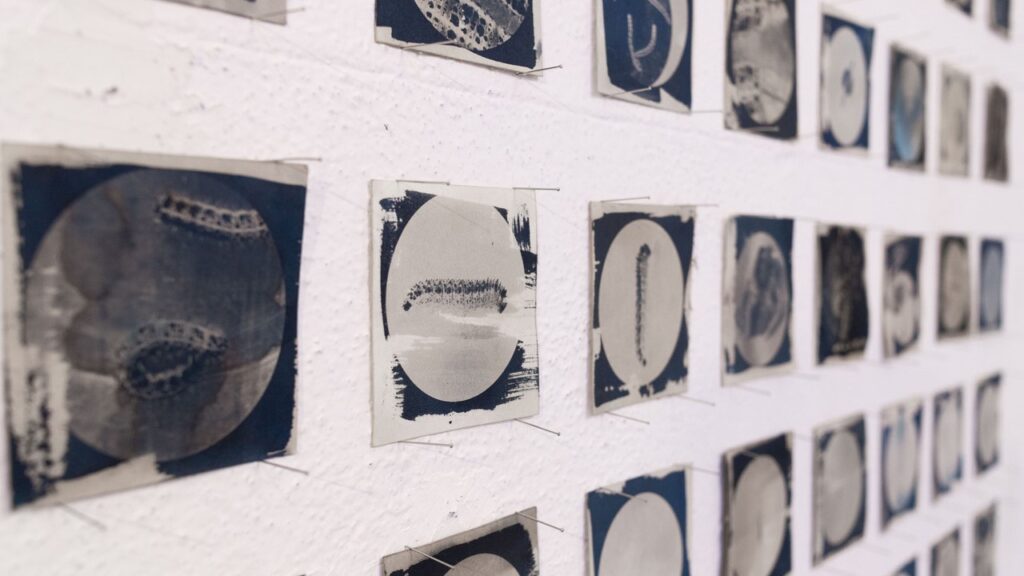
Following the birth and the process of evolution and transformation of an existence.
With the gaze of an entomologist, the camera observes and records, in the 40 days it takes for a butterfly to be born, the seemingly minimal variations in the life of the caterpillars and the construction of the cocoon, a habitat that protects and enables the mystery of metamorphosis.
For what purpose? A scientific study? A classification? A representation of life in vitro?
At the end of the process, like traces of a journey of birth and death pinned to the wall, the cocoons remain, like empty uninhabited shells, and 7×15 photographic prints, sediments placed as evidence of a poetic existential archaeology.
It is possible that during the experience some caterpillars or butterflies will not complete the transformation. It can happen; it’s the cycle of life.
The transformation is exciting and destabilising at the same time, and it’s necessary.
Il vuoto è fertile focuses primarily on the realisation and preparation for the arrival of nothingness. The moment that postpones one change and anticipates another. It settles there.
The necessary time becomes an a priori condition so that the full (the phenomena, the things) can exist and operate.
Secondly, it is about μίμησις: unable to abandon myself to change and enjoyment, I submit to you, queen of metamorphosis, I imitate you. Teach me to respect time.
Tullia Nocca, Benvenuti a casa
Tullia Nocca, Benvenuti a casa – Photographs, installation, environmental dimensions, 2023
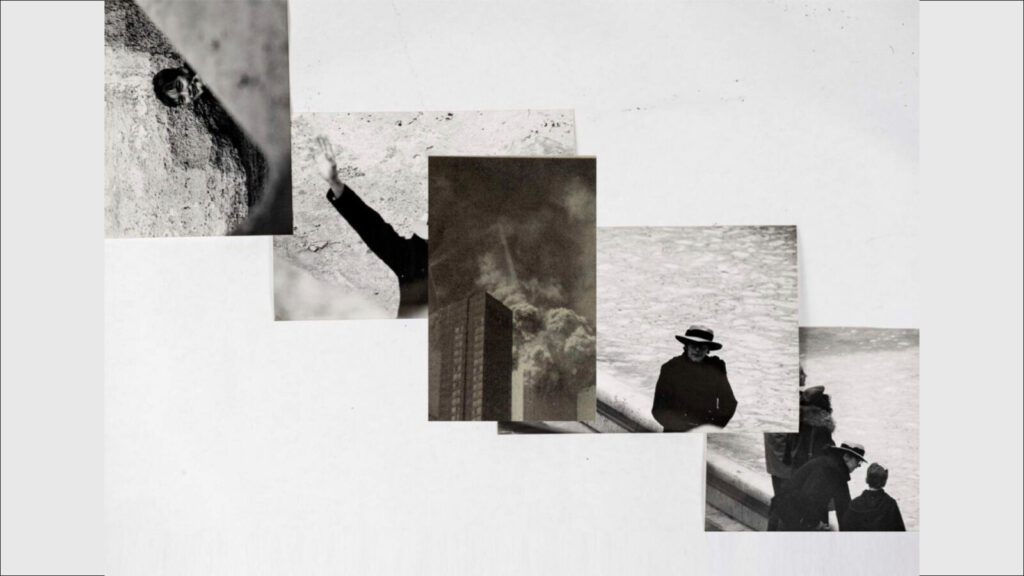
The wisest of the three built a house with concrete and bricks.
The history and personal and family identity of each person is formed and shaped by the surrounding environment, and our individual stories add up, without any kind of control or salvation, to the aggression of time and the explosion of History. But could we ever call a building without doors or windows a home?
Photography as an instantaneous and immediately retrospective gaze, as a tool for the provisional certification of individual and collective existence. Its manipulation and montage as a tragic questioning of the apparent truthfulness of memory, of the reassuring solidity of every certainty, as an attempt to reconstruct the event from the rubble.
Then I’ll huff and I’ll puff and I’ll blow your house down – cried the wolf.
Benvenuti a casa has its origin within a family archive, a journey back through individual memories and collective memories and stories.
The very disorder of the archive invites a relentless search for meaning, until one becomes aware of and sometimes understands dynamics and personal traits that have remained hidden. In the curious search among these images, a newspaper portrait of 11 September enters the process to re-signify the perception of those idyllic family images.
This process follows the dynamics of autoconstrucción proposed by the artist Abraham Cruzvillegas. This is a methodology that allows us to take emotional distance from the personal sphere and, through concrete actions performed on the archival material, induces the emergence of unconscious meanings.
Here begins a conversation between the personal and the tragedy, a close dialogue through which possible meanings explode and amplify each other. The idea of the family archive as a simulacrum of a protective cradle and a safe space is unravelled. Domestic memory collides with the historical event that revolutionised the way we perceive the certainties and images of the contemporary world. Amid the rubble of our certainties, we thus become spectators of the contrast between self-construction and destruction, in a potentially infinite dialogue. The home becomes everyone’s home, tracks that are no longer parallel collide in a process of opaque demolition/reconstruction. What remains is a restless and fragmentary perception that has emerged from the past of the proposal of new possible destinies.
Marco Pepi, Pieghe del tempo

Marco Pepi, Pieghe del tempo – Single-channel video, HD, colour, sound, 7′, 2023
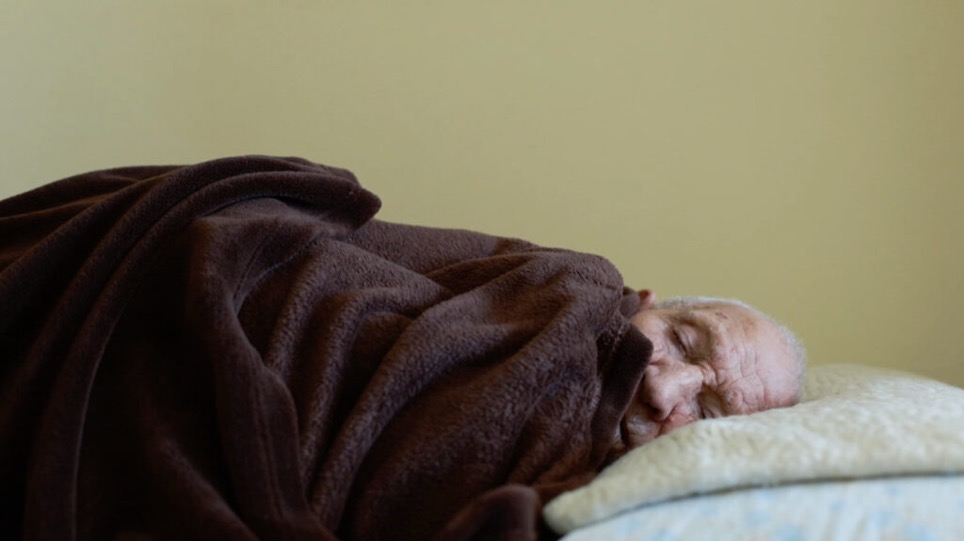
A house contains a life, love, the past, war, too much to be told, not with words that always betray memory. It is better to observe, to listen, to collect objects, gazes, memories of others and to entrust the impression of sharing to silence.
Time thickens, condensing into a detail. Off-screen, life follows its course; on the television, other stories, other wars lose substance in a dilated present that absorbs everything, as if a whole life were condensed in the waiting.
My uncle Nunzio, 104 years old, in his house that holds the memories of a lifetime.
The objects that surround him are silent witnesses of the past, his penetrating glances narrate stories of other times, episodes of his youth still imprinted in his mind.
I try to capture the personality of a man who has lived his life to the full, rich in experiences, and who offers an unforgettable glimpse into the beauty of memory and the human soul.
Maria Giovanna Sodero, La maison de Babel

Maria Giovanna Sodero, La maison de Babel – Single-channel video, HD, colour, sound, 9’40”, 2022
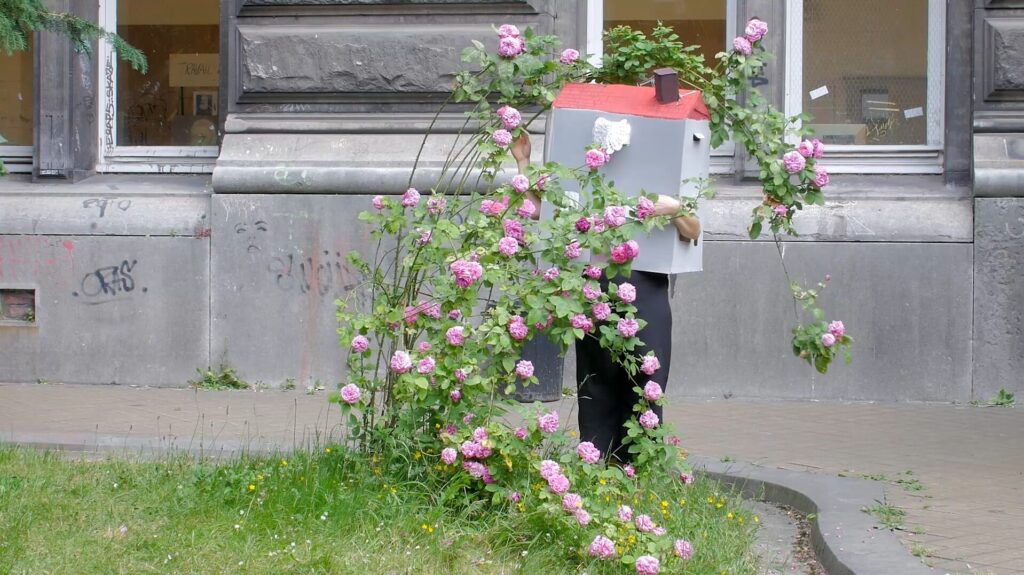
A mobile home, without roots, a migrant, wandering in a foreign land, a street home, which is lived in like a garment, which exposes itself to the city and hides, which meets people and keeps its distance, which protects like a snail’s shell and gets lost, and finds itself, and contemplates.
A video work that straddles the line between performative act, documentary and video art. Filmed in Liège at the end of the pandemic, it poetically examines living as a result of identity. Individuals as an integrated part (or perhaps not) of a complex social and cultural fabric, observed with the eyes of wonder.
It was my secret, now it will be your secret.
You need me, more than you imagine.
You seek me, you observe me and you judge me, you sometimes choose me and sometimes leave me.
You cannot always afford to have me.
Sometimes you destroy me even if you do not want to.
You water the plants that have survived the rubble, because you think that is the last bond we have left. How can a plant protect you from the wind?
You choose the boundary that unites us. It is often a small space, so small that it is an object. You are funny. You carry it with you in life and you are always afraid that it might fall and break forever.
You memorise gestures and sensations, trying to reproduce them, never letting them go, because you know very well that something will not come back, but it made you important for a moment.
I protect you, because you don’t know how to do it alone, you can’t. I separate you because often if you meet you stick together. That’s also how you are made.
There is a moment when you create, you let the light in, you choose me for that too. You choose a red curtain to colour my floors, you shut yourselves in to shelter from the cold, you talk while furnishing my rooms, often in ways that only you can understand.
You know how to smile, how to create moments that you will cherish over time. These are precisely the moments that you leave to me, that leave meaning in the corners, where you think that what you are constantly trying to remove is dust.
Article by: Chiara Picco