
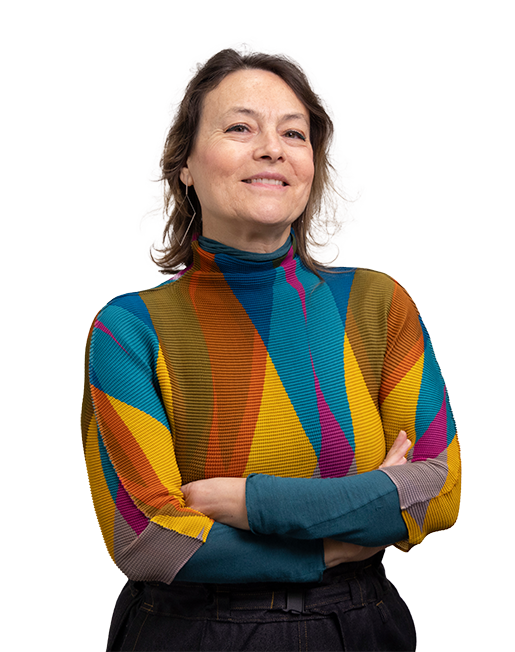
Cristina
Chiappini
Cristina Chiappini is a graphic and media designer who divides her time between Rome and Beirut.
Her studio has been operating in the field of visual communication since 1989, specialising in brand identity projects, exhibit design / environmental graphic design for exhibitions and events, motion graphics, information design, data visualisation, cultural and social communication campaigns, packaging design, editorial design, web design, and interaction design.
To find out more about Cristina Chiappini, please consult the PDF:
Learning Objectives
The Graphic Design course aims to provide students with the theoretical and technical-practical tools needed to conceive and implement a visual design project.
In particular, students are required to design Information Design / Data Visualization communication artefacts and moving banners / posters, adopting an innovative approach with a strong focus on the graphic treatment of information and the interaction between artefacts and users. The projects are intended to convey specific themes for display in an exhibition at a cultural or scientific institution or a museum.
Content
The following topics will be covered during the course:
– Types of image representation, semiotics, and information organisation.
– Typefaces: Historical overview and classifications.
– Modular typefaces (monospaced, monoscript) and variable typefaces.
– Information design / data visualisation.
– Social Responsibility of the Graphic Designer.
Assessment method
The exam comprises two parts: a presentation of the projects developed during the course and an oral examination on the topics covered in the course.
Assessment based on the projects: originality of the proposal, design process, accuracy of the final output, and presentation of the project.
Theoretical lecture notes are provided during the course.
Sinsemie. Scrittura nello spazio, Luciano Perondi, 2012.
Grid Systems in Graphic Design, Josef Müller-Brockmann, Niggli Verlag, Zurich, 1999.
Infographic Design. Visual Storytelling with Information and Data, published by Gingko Press, 2021.
Designing News, Changing the World of Editorial Design and Information Graphics, Francesco Franchi, Die Gestalten Verlag, 2013.
How Graphics Lie: Understanding Visual Information Better, Alberto Cairo, Raffaello Cortina Editore, 2020.
Learning Objectives
The Graphic Design 2 course aims to provide methodological stimuli and reflections on the new techniques of contemporary visual communication, and to equip students with the theoretical and technical-practical tools needed to conceive and implement a project for a complex Dynamic Identity system. Identities defined in this way reflect contemporary communication and are used to identify cultural and scientific institutions, museums, products and services.
Content
The workshop addresses the design of dynamic identities, covering a range of applications and communication artefacts. The workshop begins with the design of a system of signs and their variations, both static and dynamic, ranging from analogue media to the web, and from merchandising to environmental graphic design.
Introducing the concepts of Hard Identity, Soft Identity and Smart Identity, a range of case studies on the topic of dynamic identities will be analysed and presented through theoretical lectures.
Throughout the course, dedicated lectures will feature presentations by external speakers related to the project and to the Social Responsibility of Graphic Design / Social Design.
Some of the authors covered:
Umberto Eco, Italo Calvino, Bruno Munari, Giovanni Anceschi and Bruce Sterling.
Some of the historical designers covered:
Herbert Bayer, Josef Albers, Jan Tschichold, Kurt Schwitters, Wim Crouwel, Karl Gerstner, Josef Müller-Brockmann.
Some of the contemporary designers and studios covered:
Ruedi Baur, Norm, Lust, Pentagram, Lava, Bruce Mau, Paul Elliman, Stefan Sagmeister, Mevis & Van Deursen, Studio SHA, KastleBlack, Experimental Jetset, Lesley Moore, Faber & Faber, Alexis Rom Estudio, Tomato, Jonathan Harris, Anja Lutz, Andrew Blauvelt, Ji Lee, Jürg Lehni, Joachim Sauter – Artcom, Golan Levin, Toshio Iwai, Scholz & Friends, Brian Eno, Carsten Nicolai, Philippe Apeloig.
Methodology
Theory, research, context analysis, study, target audience, and reflections on case studies of dynamic identities in various communication sectors. Using a grid of characteristics, participatory, relational and generative identities are analysed.
Subsequently, a brief is assigned: a real project in which students can experience the design phases, culminating in the conception and development of a Dynamic Identity.
They develop a communication project from concept to realisation and presentation, with a focus on both individual and group work.
Teaching phases
– 1 Theoretical lectures
– 2 Launch of the project brief, meeting with the real client
– 3 Division into project groups
– 4 Research on agreed-upon aspects and case studies relevant to the brief
– 5 Group presentations of research findings
– 6 Development and presentation of concepts
– 7 Contributions from external speakers related to the project
– 8 Weekly project reviews until the final progress review
Assessment method
The exam comprises two parts: a presentation of the projects developed during the course and an oral examination on the topics covered during the course.
Assessment of the projects: originality of the proposal, project development process, accuracy of the final report, and presentation of the project.
Theoretical lecture notes are provided during the course.
Recommended reading
Open projects: Des identités non standard, Cristina Chiappini, Silvia Sfligiotti, Pyramyd, 2010.
Dynamic Identities: How to Create a Living Brand, Irene Van Nes, 2013.
Dynamic Identities in Cultural and Public Contexts, Ulrike Felsing, Lars Müller Publishers, 2010.
Further reading:
Programme Entwerfen / Designing Programmes, Karl Gerstner, 1964.
Six Memos for the Next Millennium, Italo Calvino, Einaudi, 1988.
The Open Work of Art, Umberto Eco, Bompiani, 1962.
La forma del disordine, Umberto Eco, Almanacco Bompiani, 1962.
Dynamic Identities: How to Create a Living Brand, Irene Van Nes, Bis Pub; Updated edition, 2013.
Brand Logo Design for Dynamic Identity, Giapponese, 2019.
Dynamic Logo: Dynamic Brand Identities, Dopress Books, 2013.
Graphis Archigraphia Redux, Richard Poulin, edited by B. Martin Pedersen, Graphis US Inc, 2017.
Texts on Social Design
The Incomplete Manifesto for Growth, Bruce Mau, 1998.
Bruce Mau’s 24 Principles for Designing Massive Change in Your Life and Work,
Bruce Mau, Phaidon, 2020.
First things first. Comunicare le emergenze. Il design per una contemporaneità fragile, Daniela Piscitelli List, 2019.
Designing Civic Consciousness: ABC per la ricostruzione della coscienza civile, Gianni Sinni, Quodlibet, 2019.